
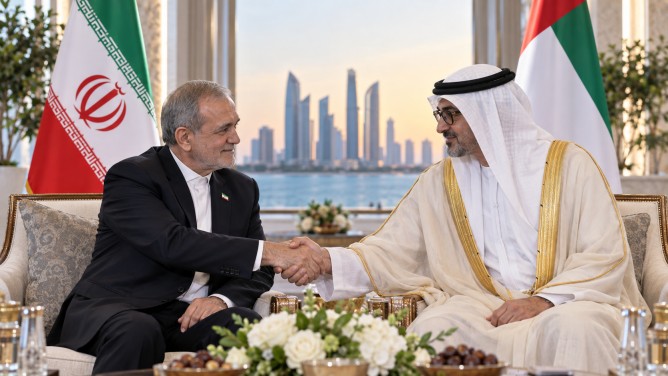
Iranian President Masoud Pezeshkian has expressed a mutual desire with the United Arab Emirates (UAE) to improve bilateral relations, signaling a shift towards reconciliation following a period of heightened regional tensions. The comments came after Pezeshkian’s meeting with Abu Dhabi Crown Prince Sheikh Khaled bin Mohamed bin Zayed Al Nahyan during the BRICS Summit held in New Delhi. Describing the engagement as constructive, the Iranian President emphasized a shared ambition to advance cooperation and focus on future collaboration.
This high-level dialogue represents the most significant contact between Iran and the UAE since recent conflicts intensified in West Asia. The relationship between the two nations had deteriorated amid escalating regional tensions, prompting the UAE to previously suspend trade and financial activities with Iran. However, the meeting underscored a renewed willingness from both parties to engage in dialogue aimed at de-escalation and regional stability.
During their discussions, Pezeshkian and Sheikh Khaled addressed a range of topics including regional and international developments, efforts to promote peace, and initiatives for fostering stability and growth. The talks occurred soon after Iran, the UAE, and other BRICS member states released a joint statement advocating for restraint in ongoing conflicts, illustrating a broader regional push towards diplomatic resolution.
Economically, the UAE remains a pivotal partner for Iran, with Dubai serving as a major commercial hub for Iranian businesses and playing a crucial role in maintaining economic activities despite the backdrop of international sanctions. This economic interdependence underscores the importance of diplomatic engagement between the two countries.
In a related development, U.S. President Donald Trump remarked that he was unconcerned about an upcoming meeting between Iran and Gulf states regarding the strategic Strait of Hormuz. This meeting, set to be held in Oman, comes amid ongoing tensions between Washington and Tehran, reflecting a complex geopolitical landscape in the region.