
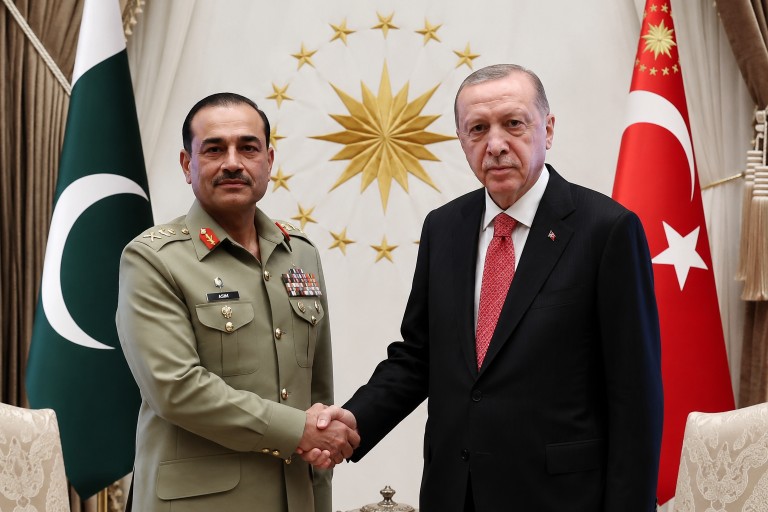
Turkish President Recep Tayyip Erdoğan recently engaged in discussions with Pakistan’s Field Marshal Asim Munir at Ankara Airport, marking a significant moment in Munir’s two-day official visit to the country. This meeting occurred just before President Erdoğan embarked on a trip to Qatar. Accompanying Erdoğan at the meeting were key Turkish officials, including Vice President Cevdet Yılmaz, Chief of General Staff Selçuk Bayraktaroğlu, and Ibrahim Kalın, the Director of the National Intelligence Organization (MIT). Previously, Munir had also held a separate meeting with Bayraktaroğlu during his visit.
The visit underscores the ongoing efforts by Türkiye and Pakistan to bolster their strategic partnership, with a particular focus on enhancing defense cooperation. This collaboration has been a cornerstone of their bilateral relationship, which has been expanding across various sectors under the leadership of President Erdoğan and Pakistan’s Prime Minister Shehbaz Sharif. Both nations have prioritized defense as a key area for mutual development and support.
Field Marshal Asim Munir has been an influential figure in Pakistan’s diplomatic landscape, actively participating in efforts to mediate regional tensions. His role in these initiatives highlights Pakistan’s commitment to playing a constructive part in regional stability and cooperation. His visit to Türkiye is seen as a continuation of these diplomatic endeavors, seeking to further solidify the ties between the two nations.
During his stay in Türkiye, Munir’s engagements with Turkish military and intelligence leaders emphasized the shared interests and strategic goals of both countries. The discussions likely covered a broad range of topics, from military collaboration to intelligence sharing, reflecting the deepening alliance between Ankara and Islamabad.
As Türkiye and Pakistan continue to nurture their relationship, the meetings held during Munir’s visit represent a step forward in their joint efforts to address common challenges and explore new opportunities for collaboration. This partnership, characterized by a strong emphasis on defense, is poised to play a significant role in shaping regional dynamics in the years to come.