
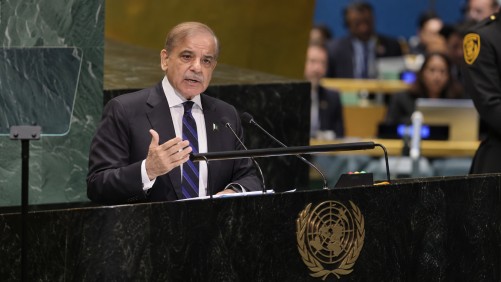
Pakistan Prime Minister Shehbaz Sharif has credited former US President Donald Trump with a crucial role in defusing tensions during a military confrontation with India in May 2025. Speaking at the 81st session of the United Nations General Assembly, Sharif highlighted Trump’s “timely intervention” at a moment when the two nuclear-armed neighbors were on the brink of a wider conflict. He emphasized the importance of preventing such situations in South Asia moving forward.
India, however, disputes this characterization, asserting that the ceasefire reached in May 2025 was the result of direct communications between India and Pakistan, with no third-party involvement. Throughout the conflict, Sharif noted that Pakistan had exercised its right to self-defense under Article 51 of the UN Charter, commending the country’s military forces for their actions.
In his address, Sharif also raised concerns over the Indus Waters Treaty, criticizing India’s decision to place the 1960 agreement in abeyance. The treaty governs the sharing of the Indus river system’s waters between the two countries. Sharif argued that the Indus river system is essential for Pakistan and the broader region, warning that any attempt to stop, impede, or divert Pakistan’s share of the waters would be regarded as an “act of war.” He claimed that Pakistan’s stance on the treaty’s ongoing validity is supported by international legal developments.
Responding to Sharif’s remarks, India, in its right of reply at the UN, accused Pakistan of perpetuating a long-standing policy of cross-border terrorism and warned of potential consequences. India reiterated its position to defend itself against terrorism and rejected Pakistan’s allegations, stating that repeated claims against New Delhi do not alter its stance on the issue.