
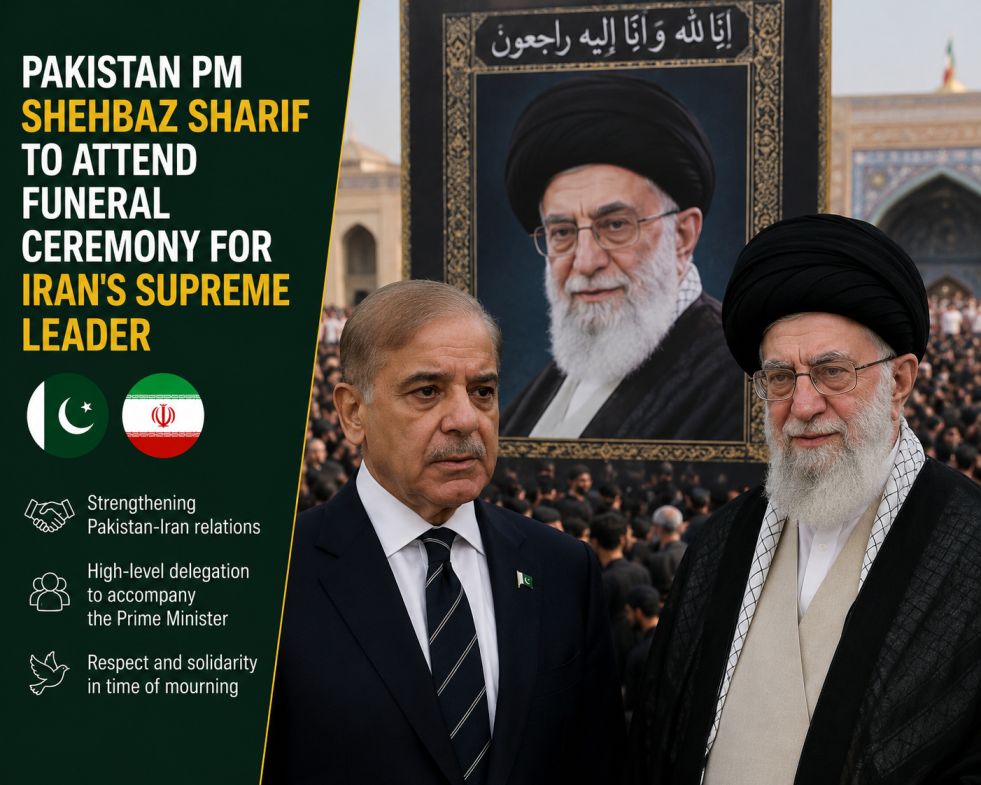
Pakistan’s Prime Minister Shehbaz Sharif is set to visit Iran to attend the funeral of Iran’s Supreme Leader Ali Khamenei, with the trip scheduled from July 3 to July 5. Following the funeral, Sharif will proceed to Türkiye for an official visit. This diplomatic engagement comes amid ongoing discussions between the United States and Iran aimed at reducing regional tensions. According to Iran’s Foreign Ministry, the funeral will be attended by representatives from approximately 100 countries, including heads of state, parliamentary leaders, and special envoys.
Among the international attendees, Tajikistan President Emomali Rahmon and Georgian President Mikheil Kavelashvili are expected to be present. Russia will be represented by Dmitry Medvedev, former president and current deputy chairman of the Security Council. China’s delegation will include He Wei, vice chairman of the Standing Committee of the National People’s Congress, while India’s representatives are Bihar Governor Syed Ata Hasnain and Minister of State for External Affairs Pabitra Margherita. The public funeral will commence in Tehran, with ceremonies culminating in Mashhad on July 9, where Khamenei will be laid to rest.
Khamenei, who became Iran’s second supreme leader in 1989, significantly influenced the country’s nuclear program and regional alliances. His leadership was marked by the expansion of Iran’s nuclear ambitions and the strengthening of ties with allied groups in the region. Khamenei died on February 28, during a U.S.-Israeli military campaign aimed at Iran’s leadership and its missile and nuclear capabilities. Following his death, Mojtaba Khamenei was appointed as the new supreme leader, continuing the legacy of his father.
The funeral occurs as the United States and Iran engage in diplomatic negotiations following a recent ceasefire after several weeks of conflict. Talks are based on a memorandum of understanding reached last month, although Israel has expressed concerns over the framework, believing it insufficiently addresses Iran’s nuclear program. These ongoing diplomatic efforts remain a focal point of international interest, with Iran’s nuclear ambitions at the center of regional and global discourse.